Landlocked
How foreign-funded activism, ESG pressure, and rival powers helped trap Canadian oil and gas inside North America.

In the winter of 2022, Germany reactivated coal plants it had promised to retire, extended its last nuclear reactors past their planned shutdown, and rushed floating LNG terminals into service on the North Sea coast. Across Europe, governments chased LNG cargoes at any price. The continent was rediscovering, in real time, that energy is not optional.
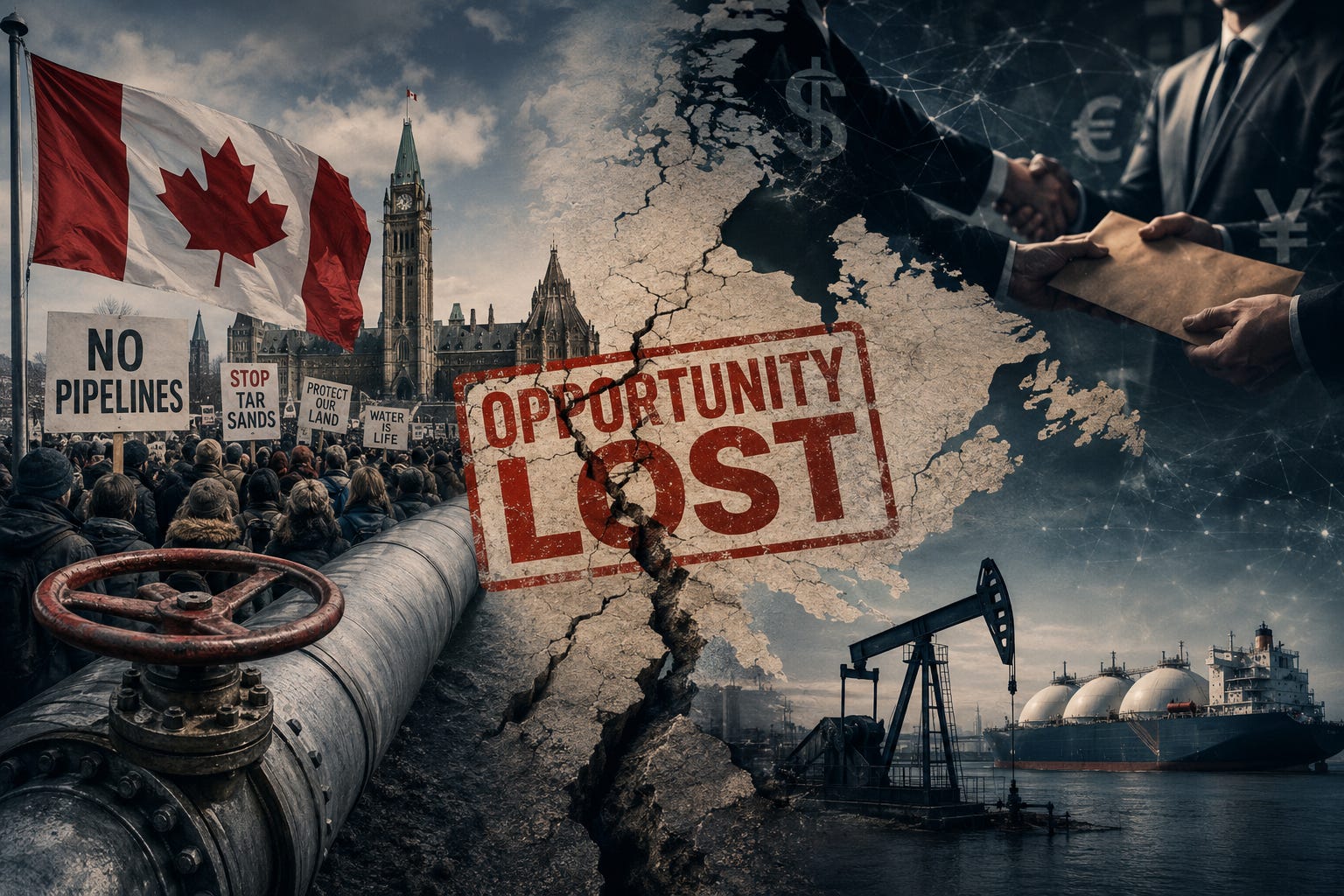
Beyond the Barrel Written by Clint Mason
That same winter, Canada was still arguing about whether it should build a pipeline to its own coast.
We sit on some of the largest combined oil and natural gas reserves on Earth. We have rule of law, two oceans, and a skilled industrial workforce. We are positioned between the United States, Asia, and Europe. By any reasonable accounting, Canada should be one of the most important democratic energy suppliers in the world.
Instead, we spent more than a decade fighting ourselves over whether we should be one at all.
Northern Gateway died. Energy East died. LNG projects stalled for years. Trans Mountain almost collapsed under political and regulatory weight before Ottawa bought it outright. Capital left. Investors hedged. Canadian crude kept flowing mostly south at a discount while competitors expanded market share around the world.
At the time, Canadians were told this was simply the cost of climate progress.
After Russia invaded Ukraine, that explanation started to look incomplete.
What the foreign money actually did
Before Russia, before ESG, before the larger geopolitical questions, start with what is already documented.
In 2019, Alberta launched a public inquiry into anti-Alberta energy campaigns. The final report, written by forensic accountant Steve Allan, found that **$1.28 billion in foreign funding flowed to Canadian environmental initiatives between 2003 and 2019.** Of that, Deloitte traced **$54.1 million specifically designated for “anti-Alberta resource development activity.”**
Allan himself was careful. He said he could not determine with precision how much of the broader $1.28 billion ultimately ended up funding anti-energy campaigns, and his report found no wrongdoing or illegal activity by any of the participants. Some critics dismissed the inquiry on that basis.
But the precise number is less important than what the report confirmed in plain language: well-funded, decade-long campaigns operated inside Canada with strategic intent to delay or block hydrocarbon infrastructure, and a meaningful share of the money came from outside the country.
A foreign-funded campaign does not need to break a law to damage a country’s interests. It only needs to delay infrastructure, raise project risk, increase capital costs, and make investment politically uncertain.
That is what happened here.
The Tar Sands Campaign became notorious for exactly that strategy. Its goal was not limited to environmental education or regulatory engagement. It targeted pipelines, export terminals, tanker traffic, financing, insurance, and public perception simultaneously. The phrase “landlock the oilsands” came from inside the campaign itself, and that’s exactly what critics watched unfold.
Funding networks tied to U.S. foundations — Rockefeller-linked philanthropy, Tides, Sea Change, Hewlett, Sierra Club affiliates — helped sustain campaigns against Northern Gateway, Energy East, Keystone XL, tanker expansion, and oilsands development.
That doesn’t make every Canadian activist a foreign agent. Many were sincere. Some still are.
But good intentions don’t erase outcomes. And the outcome was a structural reordering of how Canadian energy projects got financed, approved, insured, and defended.
To be precise about what this actually was: foreign influence did not create Canadian opposition to pipelines. It amplified it. There was always going to be domestic resistance — regional, environmental, Indigenous, regulatory. The Federal Court of Appeal killed Northern Gateway on Crown consultation grounds. The National Energy Board changed its scope on Energy East mid-process. The Tsilhqot’in decision gave First Nations real authority over their territories. None of that was foreign-funded. Those were Canadian decisions made by Canadian institutions.
What foreign money did was tilt the volume. It amplified the loudest and fuzziest version of the anti-pipeline argument over careful economic evaluation. It privileged moral framing over strategic analysis, and reputational damage over factual debate. It made the worst claims travel furthest and the strongest counter-arguments travel least. The opposition was always going to be Canadian. The volume control wasn’t.
I watched Northern Gateway die in 2016. The Federal Court of Appeal quashed the approval in June over inadequate consultation, and by November the Trudeau government had formally killed it alongside a new tanker moratorium on the northern BC coast. That was Canada’s best shot at Asian market diversification for a generation, and it ended in a single news cycle. The mood in Calgary that fall was not anger so much as a kind of confirmed dread — the recognition that we had finally been told, plainly, what large parts of the country thought of the industry that fed them.
The story many refused to tell
One of the most misleading parts of the pipeline era was how often Indigenous opinion was presented as unified.
It wasn’t.
Some Indigenous communities opposed major energy projects for serious reasons: land, water, governance, unresolved title, environmental risk, and generations of justified distrust toward governments and industry. Those concerns deserved a serious hearing. Many did not get one.
But that was never the whole story. Many Indigenous communities supported oil and gas development. Some pursued equity ownership. Some saw pipelines, LNG terminals, and resource infrastructure as a real path out of dependence on Ottawa — a way to fund schools, build local revenue, and create careers for their own people.
Those voices existed the entire time. They just attracted less attention.
Conflict draws cameras. Protest camps generate headlines. A confrontation spreads faster than a careful discussion about revenue sharing or equity participation. Outside activist networks understood that. Indigenous opposition carried enormous moral force inside Canada’s media environment, and donor-backed organizing could turn a local dispute into a national symbol almost overnight.
That doesn’t make Indigenous opposition fake. It means dozens of distinct nations, holding dozens of distinct positions, got compressed into one storyline: Indigenous people versus pipelines. That’s not how it actually was. But it’s the version that traveled.
The reality was harder. In several cases, Indigenous leaders supporting development were treated almost as an inconvenience to the preferred narrative. Their communities lost economic opportunity along with the rest of the country, and that part of the story rarely got equal weight.
Who benefited
The easiest way to read a long political conflict is to stop looking at what people said they wanted and start looking at who came out ahead.
Who gained leverage. Who gained market share. Who avoided competition.
**The United States.** Canada remained heavily dependent on U.S. refining and export infrastructure because it lacked sufficient tidewater access. Canadian crude often sold at a steep discount while American refiners captured the downstream margin. The integrated continental market brought real benefits — nobody serious denies that — but it also left Canada captive to one dominant customer with most of the logistical leverage.
**Russia.** This is where people retreat into extremes. Either every anti-pipeline group is imagined as a Moscow operation, or any mention of Russian strategic interest is dismissed as conspiracy. Neither is serious. Russia did not need operational control over Canadian activism to benefit. It only needed competing democratic suppliers to remain constrained. During the same decade Europe deepened its dependence on Russian gas, Canada repeatedly failed to build the infrastructure that could have supplied allied democracies at scale. Whether that alignment was coincidence, ideology, or amplified influence, the outcome served Moscow.
**China.** As Western countries restrained domestic resource production in the name of energy transition, China expanded industrial control over the technologies that transition requires: solar manufacturing, battery supply chains, rare earth processing, critical mineral refining. Canada blocked pipelines while importing more foreign-made green technology, much of it tied to coal-heavy industrial systems overseas. That contradiction almost never got the same scrutiny as domestic hydrocarbon emissions.
Constrained Canadian supply didn’t create a vacuum. It created room for someone else.
The Ukraine wake-up call
For years, Canadians were told energy security was yesterday’s problem. Globalization would stabilize supply chains. Markets would balance themselves. Renewables would replace hydrocarbons quickly. Domestic production was increasingly framed less as a strategic asset than as a political embarrassment.
Then Russia invaded Ukraine.
European governments that had discouraged fossil fuel development scrambled for LNG. Coal plants reopened. Nuclear returned to the conversation. Energy security went from unfashionable to existential in roughly six weeks.
The contradiction was hard to miss. Germany, Japan, South Korea, Greece, and other allied economies had already approached Canada about long-term LNG supply. These weren’t speculative buyers. They were advanced industrial economies looking for stable supply outside authoritarian systems.
And Canadians had been told, repeatedly, that there was “no business case” for major LNG export infrastructure.
That claim has aged badly. The demand existed. The buyers existed. The geopolitical case was obvious. What Canada lacked was not opportunity — it was political certainty, infrastructure clarity, and institutional confidence.
At some point “no business case” stopped sounding like economic analysis and started sounding like narrative management.
I sat in plenty of industry meetings during the European scramble of 2022. Everyone in those rooms had the same question, and people kept asking it like they couldn’t quite believe the answer: how did Canada spend a decade arguing itself out of supplying allies it should have been supplying all along?
Nobody had a clean answer. We just had the answer.
By the mid-2010s, anti-pipeline politics no longer lived only outside government. People with environmental NGO backgrounds had moved into Liberal political machinery, cabinet, and senior advisory roles. The governing party didn’t just face pressure from activists. It absorbed their language, priorities, and moral framing. Pipelines stopped being treated as strategic infrastructure and became political liabilities requiring social licence and reputational management.
Markets noticed. Capital does not invest confidently into sectors governments are visibly embarrassed to support.
I watched Energy East die a year after Northern Gateway. TransCanada walked away in October 2017 after the National Energy Board signalled it would weigh upstream and downstream emissions in its decision — moving the regulatory goalposts mid-process on a project already years in development. A pipeline that would have moved 1.1 million barrels a day from Alberta to refineries in Quebec and New Brunswick, eliminating most of our reliance on imported foreign oil to feed our own East Coast, was suddenly a political embarrassment instead of a national project.
The whole episode looks surreal in hindsight. Canada arguing about whether Eastern Canada should receive Canadian oil through Canadian infrastructure, while Europe deepened its dependence on Russian supply. We turned one of our greatest strategic advantages into something parts of the country began to treat as a national shame.
That may have been the most successful political reframing of the era.
The information war was already here
Ukraine also gave the West a visible lesson in how foreign influence actually works.
It does not arrive with a Russian flag on the profile picture. It arrives as outrage, exhaustion, and cynicism. As emotional narratives repeated until people stop evaluating them.
Since the invasion, Western audiences have been flooded with familiar refrains: Ukraine is corrupt, NATO caused the war, Zelensky is a Nazi, aid money is being stolen, Russia is somehow the victim of a war it launched. These narratives are not random. Russia has spent years refining information warfare designed to exploit division, institutional distrust, and algorithmic amplification inside democratic societies. The U.S. Department of Justice has documented AI-assisted Russian bot networks targeting exactly those themes.
The goal is not always to make everyone believe one story. Often it is enough to create confusion, polarization, and fatigue. Make people angry enough, often enough, and eventually they stop evaluating information at all.
Canada was not immune. Pipeline debates became emotional cultural conflicts instead of practical discussions about infrastructure and trade. That doesn’t prove every anti-pipeline campaign was directed from Moscow. But it does prove that Canada’s resource debates were never sealed off from the outside world. They were visible, exploitable, and useful.
Once you understand that, the idea that Canadian energy politics existed in isolation from broader geopolitical competition becomes hard to take seriously.
When energy became a moral question
Somewhere between 2010 and 2020, oil and gas stopped being discussed mainly as infrastructure, employment, or export revenue. It became a moral question.
Supporting pipelines was no longer support for transportation infrastructure. In many circles, it became evidence of being anti-environmental, politically backward, or indifferent to climate change.
Once that happens, honest trade-offs become almost impossible to discuss.
Should Canada diversify exports beyond the United States? Should democratic allies buy Canadian LNG instead of Russian gas? How do we lower emissions without weakening industrial competitiveness? How do we fund healthcare, pensions, and public services while undercutting the industries paying for them?
Those questions got compressed into a simpler frame. Pipelines became symbols of environmental failure. Opposition became proof of virtue. That framing spread through universities, media, corporate branding, government communications, and eventually large parts of the federal bureaucracy.
The contradiction was never resolved. Much of the country remained deeply dependent on the very industries it was increasingly being asked to find shameful.
Most of the people I worked alongside in the industry weren’t climate deniers. They were engineers, geologists, operators, fabricators, and technical workers who understood something the political conversation kept dodging: modern life is still built on hydrocarbons. Not just gasoline. Agriculture, fertilizer, mining, steel, concrete, plastics, heavy transportation, petrochemicals, manufacturing, backup power, industrial heat, global shipping. Even most green technologies depend heavily on hydrocarbons during mining, manufacturing, and construction.
The public conversation increasingly treated hydrocarbons as a political preference. The actual world treated them as a foundational input.
Meanwhile the global market kept behaving according to physics rather than press releases. Asia kept industrializing. China kept building coal plants. Russia kept exporting energy. OPEC kept defending market share. Canada was arguing about whether to supply a market that was very clearly still buying.
When the money picked a side
At roughly the same time energy became a moral question culturally, ESG started reshaping how it got financed.
On paper, ESG sounded harmless. Companies should operate safely. Boards should be accountable. Fine. Most people in the industry would have signed that page without a second thought.
But ESG didn’t stay on paper. Banks reassessed hydrocarbon exposure. Pension funds faced activist pressure. Insurers reconsidered project coverage. Institutional investors adopted climate-screening rules. Public companies absorbed reputational campaigns. What started as governance became a filter, and the filter quietly excluded one industry while leaving most others alone.
In practice, ESG created a rising financial penalty around long-term hydrocarbon investment inside democratic countries while global energy demand kept growing.
Canada was especially exposed. Our economy relies heavily on resource development, and our institutions are unusually sensitive to international financial trends. Western capital began behaving as though hydrocarbons were disappearing tomorrow. They weren’t. The question was who would supply them.
The answer turned out to be state-controlled producers, OPEC members, and authoritarian governments operating with far weaker activist pressure and almost no ESG constraint. Canada handicapped parts of its own economy while competitors operated under different rules.
Raising that concern carried social and professional risk. Critics were dismissed as anti-environmental or anti-science, even when they were raising practical questions about energy security, competitiveness, and long-term industrial capacity.
Capital responds to confidence. Once major institutions reinforce the same narrative simultaneously, dissent becomes expensive.
What it cost
The damage wasn’t theoretical.
Conservative math: if Canada lost or delayed roughly **0.5 to 1.0 million barrels per day of export capacity over a decade**, at average Brent values near $60/bbl, the gross export opportunity alone falls somewhere between **$110 billion and $220 billion USD**. Add roughly **3 to 5 Bcf/d of delayed LNG capacity** at modest gas prices, and the combined export gap gets significantly larger.
Those numbers exclude the indirect costs.
We now have real evidence of what improved tidewater access is worth. Since TMX entered commercial service in May 2024, the WCS-WTI differential narrowed by about $6–8 per barrel on average. Alberta Central estimates the discount reduction generated roughly **C$10–13 billion in additional producer revenues in the first year alone.** Year one. One pipeline.
Apply that lesson backwards. A decade of additional tidewater access — through Northern Gateway, Energy East, expanded TMX timing, and earlier LNG — would have generated tens of billions more in narrowed differentials on existing production. On top of new exports. On top of investment, royalties, taxes, engineering services, Indigenous equity participation, and the broader productivity multiplier that comes with confident industrial sectors.
Then comes the environmental contradiction.
There is no credible evidence that blocking Canadian export infrastructure reduced global oil or gas consumption. The IEA’s Global Energy Review shows global oil demand continued rising through 2024 and natural gas demand reached record highs. The fuel was still burned. The demand was still there. The only thing that changed was who supplied it, who collected the revenue, who gained the leverage, and under what environmental standards it was produced.
If the practical outcome was reduced Canadian participation while global consumption continued anyway, that was not a climate victory. It was market share transfer.
Canadian oil and gas is not impact-free, and nobody serious in the industry pretends otherwise. But Canada is a regulated democracy with environmental review, public reporting, methane regulation, reclamation obligations, labour standards, Indigenous consultation requirements, and legal accountability. Many of the barrels and molecules that replaced ours don’t operate under anything close to the same oversight.
We lost jobs, revenue, and strategic leverage. The world still burned the fuel. In some cases it burned worse fuel.
That isn’t environmental progress. That is outsourcing the footprint while pretending the problem was solved.
The illusion of moral superiority
One of the defining features of this period was the belief that Canada could distance itself from the physical realities of industrial civilization while continuing to enjoy all its benefits.
We increasingly behaved as though producing resources was morally suspect while consuming them remained perfectly fine.
People still heated homes, drove cars, flew on airplanes, bought goods shipped across oceans, and relied on fertilizer-fed agriculture and global manufacturing. But politically and culturally, much of the West began treating extraction itself as the problem, separate from the consumption it enabled.
That created moral outsourcing. We didn’t stop consuming. We just got more comfortable importing — oil from elsewhere, manufacturing from elsewhere, steel from elsewhere, solar panels from elsewhere, processed critical minerals from elsewhere. Often from jurisdictions with weaker environmental standards and lower labour protections than Canada itself.
A democracy producing hydrocarbons under strict regulation is not strategically equivalent to authoritarian states controlling global energy supply. A country importing coal-produced solar panels is not necessarily reducing its true industrial footprint. A country blocking pipelines while importing foreign oil is not operating from a coherent environmental position.
Sometimes it is just transferring production elsewhere while weakening itself in the process.
Was it coordinated?
Readers tend to go to one of two extremes here, and both are wrong. Either this all proves a centralized conspiracy directing activists, governments, media, and financial institutions in unison. Or none of it means anything because nobody can produce a smoking gun showing every actor was secretly aligned.
Both reactions miss how modern influence actually works.
Modern influence rarely runs through a single command structure. It runs through *alignment*. Activists pursue ideology. Politicians pursue electoral advantage. Media follow narratives that resonate. Financial institutions manage ESG positioning. Foreign governments pursue national interest. Competing industries pursue market share.
None of those actors need to sit in the same room for their efforts to point in the same direction.
In Canada’s case, the direction became hard to ignore: constrained pipelines, delayed LNG, reduced export capacity, weakened investor confidence, declining confidence in our own industrial strengths. Some participants believed completely in what they were doing. Others saw political opportunity. Institutions followed social pressure. Corporations followed financial incentives. Foreign competitors recognized strategic advantage in the outcome.
Russia did not need to direct every Canadian activist organization to benefit from Europe staying dependent on Russian gas. China did not need to control Canadian climate politics to benefit from Western dependence on Chinese manufacturing. American refiners did not need to organize protests to benefit from discounted Canadian crude trapped largely inside North America.
The outcome itself created the advantage.
Democracies are vulnerable to this because free societies allow activism, foreign funding, institutional lobbying, media campaigns, and ideological movements to operate openly. Most of it happens legally.
That is the uncomfortable part. A country does not need to be conquered to be strategically weakened. Sometimes it just talks itself into surrender.
The blind spot
Every serious power thinks strategically about energy.
The United States does. Russia does. China does. Saudi Arabia does. Norway does. They understand something Canada became uncomfortable admitting: energy is not just another industry. It is economic, industrial, trade, manufacturing, and geopolitical leverage at the same time.
Canada had every advantage. Massive reserves. Political stability. Technical expertise. Strong environmental oversight. Rule of law. Allied democracies as ready buyers. A skilled workforce. Enormous LNG potential.
And for much of the last decade, Canada often behaved like a country embarrassed by the industries paying for much of its prosperity.
That was the blind spot. We viewed resource development through domestic political optics rather than national strategy. Pipelines became liabilities instead of infrastructure. The oilsands became a symbol of moral failure instead of an asset to improve. LNG became controversial while allied democracies searched globally for stable, non-authoritarian supply.
The rest of the world kept operating according to reality. China secured industrial supply chains. Russia weaponized dependency. The U.S. protected strategic industries while quietly benefiting from Canadian market captivity. Middle Eastern producers defended share.
Canada was still arguing with itself about whether to act like a resource power at all.
The irony is that we were positioned to *lower* global risk. Canadian LNG could have displaced higher-emission coal generation in Asia. Canadian exports could have strengthened allied energy security. Our production already operates under stricter standards than most competing supply. Canadian resource wealth could have financed infrastructure, innovation, Indigenous equity, debt reduction, and long-term industrial development.
Instead, much of the national conversation focused on how quickly we could distance ourselves from the industries that built modern prosperity in the first place.
Countries that lose confidence in their own strengths do not eliminate global competition. They just weaken themselves inside it.
What now
Diagnosis is the easy part. The harder question is what Canada does next.
Start with the rhetoric. The reflexive “this will destroy the environment” framing has to stop being treated as the default serious position. We can have rigorous environmental review, methane regulation, reclamation obligations, Indigenous consultation, and proper oversight — *and* build pipelines. Those are not opposites. They are the conditions under which a serious country builds infrastructure.
We already do this. Thousands of oil tankers move in and out of the East Coast every year. Foreign tankers come right up the St. Lawrence carrying foreign crude, refuelling refineries in Quebec and the Maritimes, and nobody treats it as an environmental catastrophe. We have the knowledge. We have the regulatory framework. We have the technical workforce. We have been moving hydrocarbons safely for decades. The argument that Canadian tankers on the BC coast are an unmanageable risk while foreign tankers on the St. Lawrence are routine commerce is not an environmental argument. It is a political position wearing environmental clothing.
Build the pipelines. Build the LNG. Build the ports — east, west, north, south — and the rail and the roads that connect them. We are not just an oil and gas country. We are a *resource* country: oil, gas, minerals, coal, lumber, critical metals, agriculture, processed materials, and the industrial expertise to develop all of it responsibly. Every one of those sectors needs the same thing — infrastructure that connects Canadian production to global markets without routing through American intermediaries first.
This is not a partisan position. It is the position every other major resource producer has already adopted. Australia did it. Norway did it. The United States did it. Even Russia and the Gulf states did it — *especially* them. Canada is the only major resource producer that spent a decade arguing with itself about whether it should act like one.
There is no version of national strength in this century that does not involve building. We can build well, with proper oversight and Indigenous partnership and stricter environmental standards than anywhere else on Earth. Or we can keep importing finished goods made from raw materials we exported at a discount, and pretend that is a climate strategy.
It isn’t. It never was.
The real question
Maybe the biggest mistake Canadians made was assuming foreign influence only looks like espionage, hacked servers, or suitcases full of cash.
Modern influence is quieter than that. It moves through incentives, funding, institutions, narratives, social pressure, finance, activism, politics, and algorithms. Most of it happens legally. And none of it requires every participant to understand the larger outcome they are helping create.
That is what makes open societies vulnerable. Some actors are motivated by ideology. Some by profit. Some by environmental conviction. Some by geopolitical advantage. Eventually outcomes matter more than intentions.
The outcome here became hard to deny: delayed infrastructure, weakened investment, reduced export capacity, deepened dependence on foreign manufacturing, continued U.S. market captivity, and a slow erosion of confidence in the industries that built much of the country.
Meanwhile the world did not stop competing. Russia pursued energy leverage. China pursued industrial dominance. The United States pursued strategic self-interest. OPEC defended market share.
Canada debated whether developing its own resources was morally acceptable at all.
The greatest failure was not that foreign actors pursued their own interests. Every major power does that.
The real failure was that Canada gradually stopped pursuing its own.
Sources
[1] International Energy Agency, *World Energy Outlook 2022* and *2023*, on Europe’s reliance on Russian natural gas and post-Ukraine energy-security pivots.
[2] European Commission, REPowerEU plan documentation on diversification away from Russian fossil fuels.
[3] IEA, *Special Report on Solar PV Global Supply Chains* (2022) — Chinese dominance across major manufacturing stages.
[4] *Report of the Public Inquiry into Anti-Alberta Energy Campaigns* (Allan Inquiry, 2021), including Deloitte forensic accounting. Foreign funding to Canadian environmental initiatives totalled approximately $1.28 billion between 2003 and 2019; approximately $54.1 million was specifically designated for anti-Alberta resource development activity. The inquiry found no wrongdoing or illegal activity.
[5] Tar Sands Campaign strategy documents and Allan Inquiry appendices referencing “landlock” strategy language.
[6] Reuters reporting (2022–2024) on Germany, Greece, Japan, and other LNG interest in Canadian supply. LNG Canada ownership: Shell, Petronas, PetroChina, Mitsubishi, Korea Gas.
[7] U.S. Department of Justice and Treasury actions (2024) against Russian state-linked influence and AI-assisted bot operations targeting Western political polarization.
[8] Alberta Central, *TMX Year One* analysis (2025): WCS-WTI spread narrowed ~$6–8/bbl on average, generating approximately C$10–13 billion in additional Canadian producer revenues in the first year of TMX expansion operations.
[9] IEA, *Global Energy Review 2025* — global oil demand continued rising through 2024.
[10] IEA, *Global Energy Review 2025* — global natural gas demand reached record highs in 2024.
A strong and solid piece … almost painful to read at all that has been lost because of the lack of vision … or should I say, common sense.
I largely agree with this, but there are some points I will push back on or caveat.
I think Energy East had far less to do with Canadian regulation than the approval of KXL. The US Gulf coast is really the only market we could feed bitumen to, and KXL offered both a shorter pipeline and no shipping requirement. Maybe you could find 100-200bbl/ in Europe and the Caribbean, but I doubt that would have been the material market, and it could very reasonable be served by RailBit.
I do think there is a certain hypocrisy in the Canadian oil conversation on needing to use our own oil and cut imports. Almost all our imports come from the US. We (rightfully) demand fair access to their market for our exports, but seem to balk at the idea we would import oil from them, even when it is a different grade in a different part of the continent. Irving in particular exports something like 2/3rds of output to the US - is it really wrong that we would be processing American oil to feed that?
I am very much hesitant to believe that building a new 1000km pipe from Montreal to St. John to feed a 300kbbl/d refinery (which frankly, is among the more economically precarious in Canada, and I don’t know will exist when the pipeline gets there) makes sense, and again if some bitumen is needed, railbit is an option. That said, I would like to see part of the TransCanada NG pipeline (one of the 42” segments of the four pipes) converted to carry RPPs, NGLs, and Synthetic crude, and have the Line 9 re-reversed to bring that to Sarnia. But I have very little appetite for DilBit to be shipped along the coast of Lake Superior.
In fact, I don’t have much appetite for shipping DilBit at all, and I do think the comparisons made with oil on the St. Laurent are somewhat misleading. I do think it is critical we expand West Coast access, where there is pacific demand for heavy crude (and growing at that). I think it will be DilBit that is shipped - but I wish the environmentalist would fight for a requirement that this is partially upgraded at the least, so that a spill floats, rather than fight the pipeline outright.
The Tar sands campaign was filled with a lot of misinformation, the term “tar” being the start. I will say, however, the other area I am uncomfortable with around our oil industry and the environment is the tailings ponds, particularly the PFT tailings that are growing so quickly while the work on NFT tailings is used to show progress. I am concerned if not confident that eventually, when oil prices are low again in the future, Imperial or otherwise is going to simply declare bankruptcy and walk away from the clean up. Again, I wish environmentalists could draw a distinction between fighting the Mines and the In-Situ aspects of the industry, because there really, really should be more pressure on the mines.
The last thing I will say about ESG and investment, is that there is a contradiction between investment and current demand. Even needing the oil today, investors aren’t going to back a 30 year project they think will be shaky in a decade. Frankly, if there is one reason I voted for Carney, it is because he understood the concept of a Minsky moment, and that capital by necessity retreats ahead of demand which in tern creates an economic imbalance where companies seemingly profitable today are suddenly insolvent tomorrow. I think in this framing it is clearer why publicly owned oil sectors have not seen this issue - shareholder aren’t pulling money out with buy backs and banks aren’t accessing risk. And again, those tailing liabilities really accentuate that.
All that said, as I started, I do largely agree. I agree we will get more value buy building tide water access, I agree we should be able to serve most eastern refineries with pipelines fully within national boundaries, and I agree there was a wide alignment of campaigns with both heartfelt and nefarious reasons aiming to slow or paralyze the industry. And frankly, if we can’t put the industry on long-term legs, the liability dumping will be in earnest.
But oh boy, do I wish we would take the asphaltenes out of the bitumen before putting it to sea, and I wish we would do something with them other than pour it in a hole in the ground for later.
Edit: Also, before 2020, LNG prices really were quite weak, and the only way Canadian LNG really makes sense is of we can convince partners it is a safe hedge and environmentally better, and so worth the premium of getting it over a mountain range and building the greenfield liquification infrastructure. Qatar is far cheaper, and the US had a lot of brownfield infrastructure to repurpose. I’m pretty bearish on LNG, while I am much more bullish on heavy crude.