The Equalization Lie: How Quebec Exploits the System While Calling It Fair

A detailed breakdown of GDP, tax flows, and transfers proves Canada’s redistribution system punishes productivity and rewards manipulation.
By Clint Mason
What if I told you the province with the second-highest economy per capita in Canada receives over 50% of the country’s equalization payments—while contributing thousands less per person in federal taxes than the provinces that fund it?
It would sound like a conspiracy, but it’s not. It’s Canada’s equalization program—and Quebec has mastered how to game it.
Equalization: From Principle to Problem
Canada’s equalization program was introduced in 1957 with good intentions: ensure all provinces can deliver “reasonably comparable levels of public services” without having to impose “unduly high levels of taxation.” A noble goal in a country as geographically and economically diverse as ours.
But noble goals don’t survive political convenience.
What began as a temporary measure has become a permanent fixture of Canadian federalism—one that quietly shifts wealth from provinces that build, extract, and produce to those that regulate, obstruct, and underperform. Even worse, it does so with no strings attached.
Equalization doesn’t require reform, austerity, or accountability. It just keeps flowing—regardless of whether the recipient improves or declines.
The Numbers That Matter
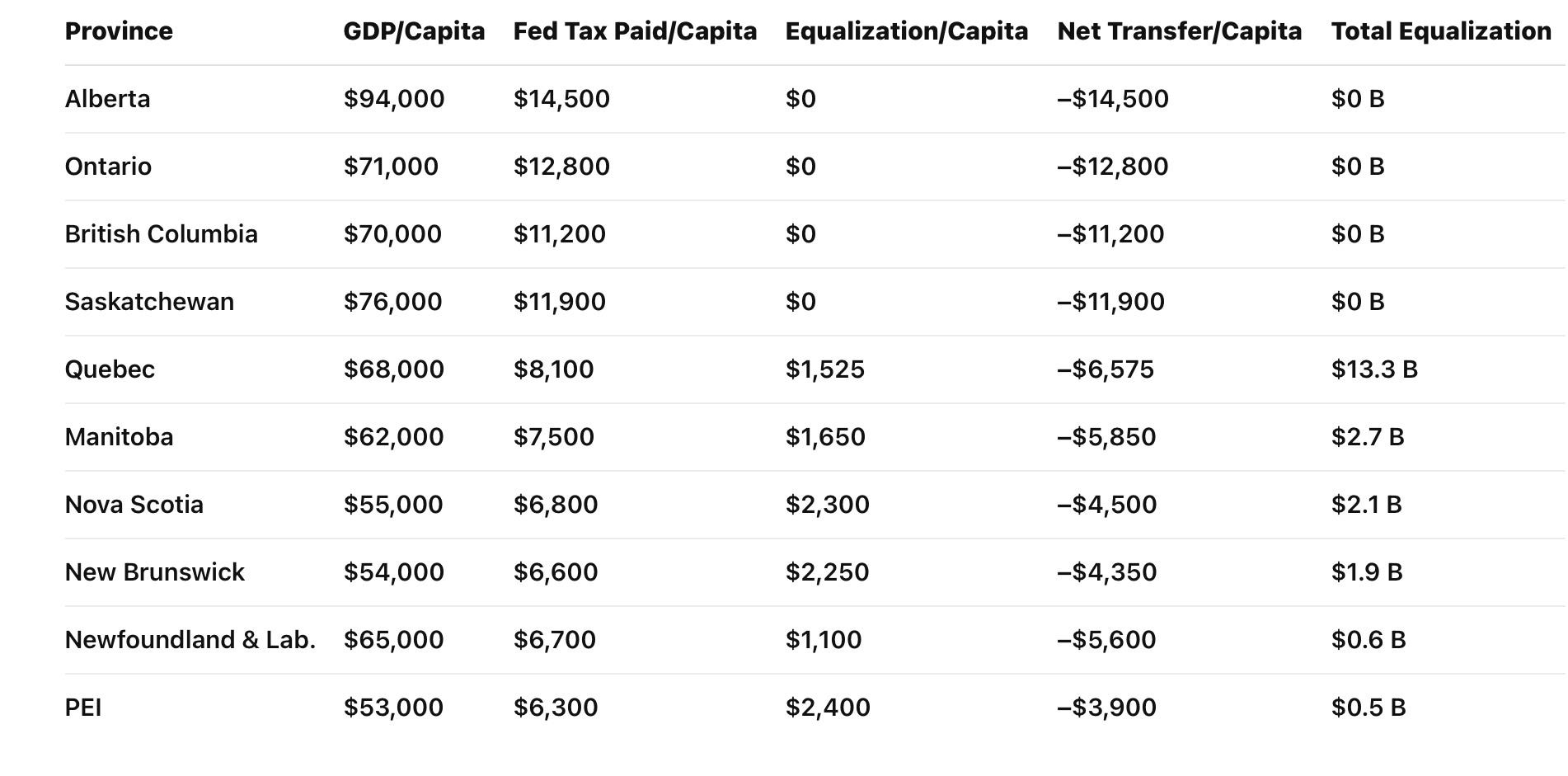
Let’s get to the raw data. Below is a breakdown of 10 provinces using GDP per capita, federal taxes paid per capita, and equalization received per capita. It tells the story clearly: the provinces doing the most to drive Canada’s economy are subsidizing the rest—and Quebec is the biggest winner.
The Hydro Loophole: Quebec’s Untouchable Advantage
So how does Quebec manage to appear poor enough to qualify for over $13 billion in equalization while boasting strong GDP numbers and world-class infrastructure?
Two words: Hydro-Québec.
Hydro-Québec is a crown corporation that generates tens of billions in revenue annually and returns massive profits to the province through dividends and artificially low electricity prices. But here’s the trick: those hydroelectric profits aren’t fully counted as “resource revenue” under the federal equalization formula.
Meanwhile, Alberta’s oil royalties and Saskatchewan’s potash profits are included—albeit partially. This discrepancy skews Quebec’s “fiscal capacity” on paper, making it appear less wealthy than it actually is.
In short, Quebec hides its wealth behind water, and the formula lets it happen.
A Rigged System With No Incentive to Improve
If you can collect billions in federal cash every year without raising taxes or growing your economy, why would you ever change?
That’s the problem with Canada’s equalization model today:
It removes incentives for economic reform in recipient provinces.
It punishes productive provinces with high federal tax bills.
It distorts national politics by aligning Ottawa’s interests with votes in dependent regions.
It enables provincial governments to resist responsible development (like oil and gas) without facing budget consequences.
Imagine Alberta refusing to develop its oil sands while still collecting $13 billion in equalization. That’s what Quebec does every year—with zero accountability.
A Fairer Future: Equalization Reform That Works
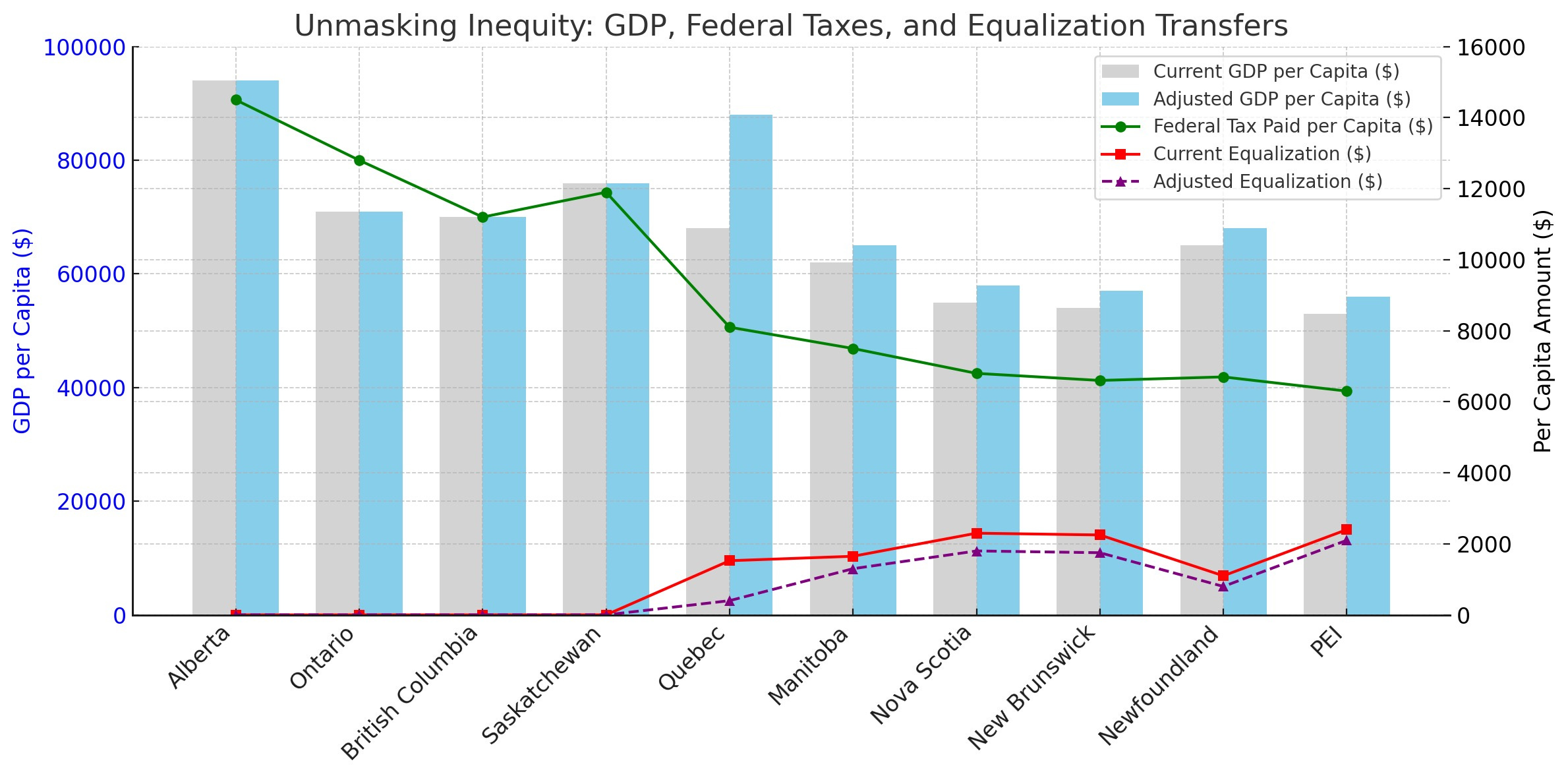
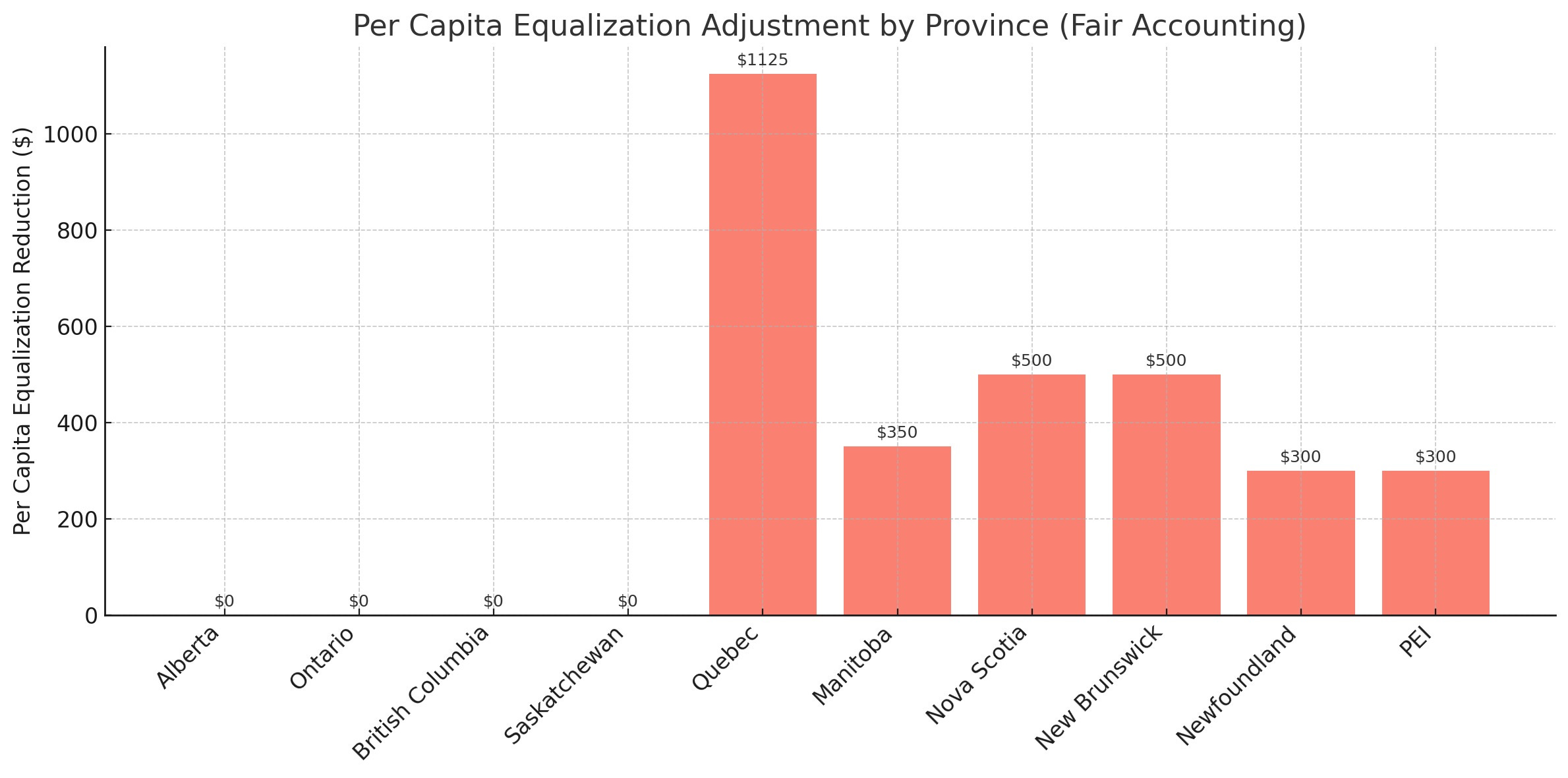
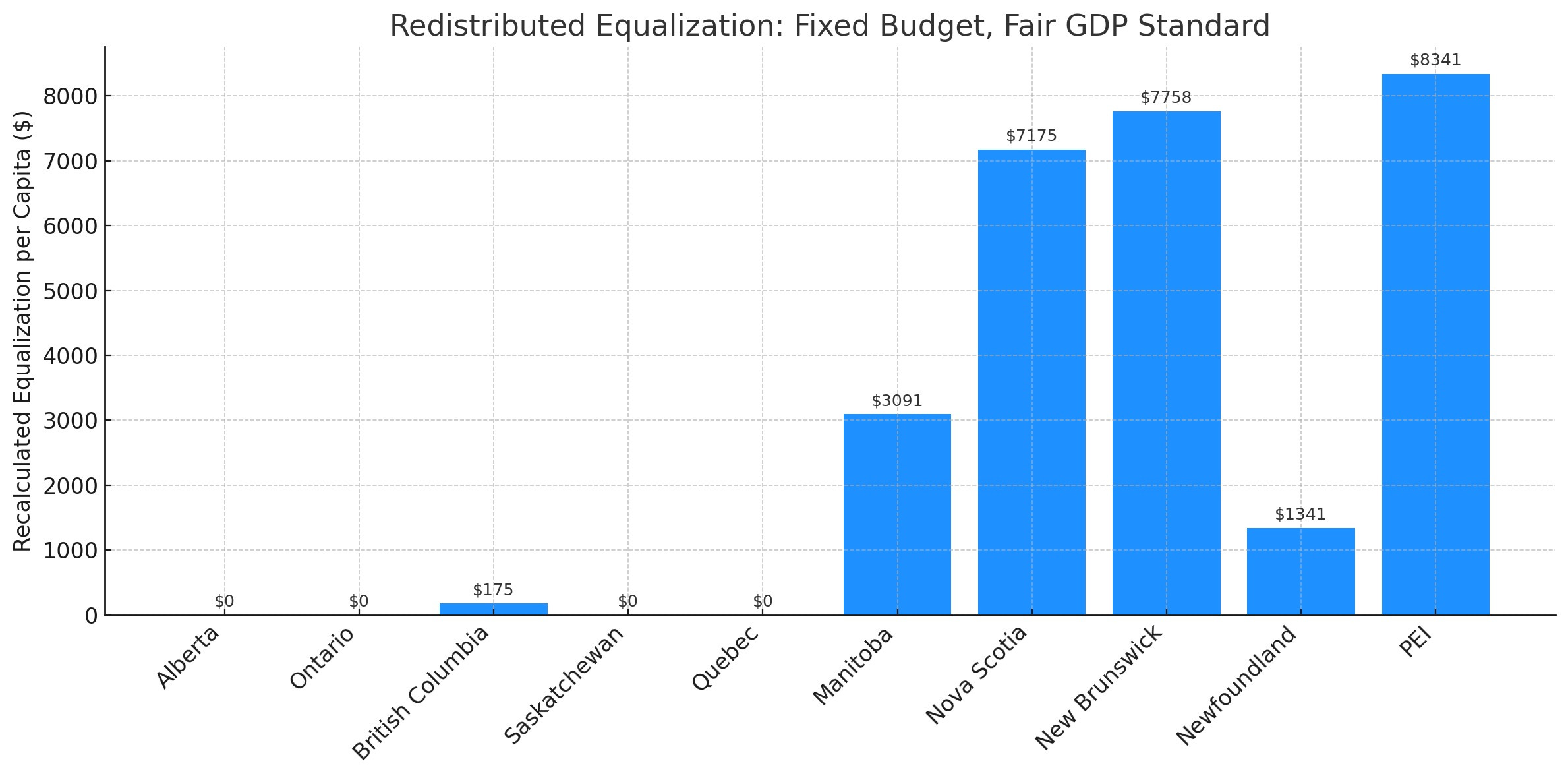
Reforming equalization doesn’t mean abandoning those in need. It means applying the same rules to everyone—and rewarding improvement instead of stagnation.
Here’s a five-part fix:
Include all resource revenues equally. Hydro, oil, gas, potash—it all counts.
Phase out the existing formula over 5 years.
Replace it with a Performance-Based Fund that rewards provinces for improving fiscal health, cutting deficits, or increasing revenue efficiency.
Repatriate 10–15% of federal tax room to the provinces—giving them more autonomy and making Ottawa leaner.
Mandate transparency on fiscal capacity calculations, so the public can see how each province is treated.
Under this plan, equalization is no longer a permanent lifeline—it becomes a ladder for provinces to climb.
Fixing the Federation: Giving Provinces Control of Their Dollars
The federal government currently takes in about $500 billion annually. A significant chunk of that gets funneled into provincial responsibilities: healthcare, education, infrastructure, housing.
But why should Ottawa act as the middleman?
If we reduce federal taxes by 10–15% and allow provinces to collect that room directly, provinces gain financial sovereignty while taxpayers get more transparent service delivery.
In Alberta, this would leave $1,397 per capita in the province. In Ontario, $1,357. Those numbers aren’t theoretical—they represent economic power being returned to where it’s earned.
And While We’re At It… Fix the Federal Budget
Our current equalization system is only part of the larger problem: Ottawa’s fiscal mismanagement.
We currently pay $54 billion per year in debt interest—about the same as we collect in GST. If we cut discretionary spending by just 50%, we could:
Eliminate the federal deficit in Year 1
Achieve surpluses by Year 2
Cut interest payments by 50% within 6 years
Eliminate the federal debt in 15 years
This is all possible without touching healthcare transfers, defense, infrastructure, or security.
The obstacle isn’t economics. It’s politics.
A Nation That Rewards Strength, Not Slack
Equalization has quietly become a tool for entrenching political dependency, shielding fiscal mismanagement, and centralizing power in Ottawa. But Canadians are waking up to the reality.
They’re asking:
Why do I pay more and get less?
Why is productivity punished?
Why is Quebec calling the shots when Alberta’s footing the bill?
There’s no good answer—only excuses.
It’s time for fairness. It’s time for reform.
Let’s build a federation that doesn’t bleed its strongest provinces dry just to pretend the system works.
Because right now—it doesn’t.
“Until we stop allowing provinces like Quebec to exclude billions in hydroelectric resource wealth while draining equalization from those who develop their full economic potential, resentment in the West will only grow. The path forward isn’t more bureaucracy — it’s fairness. A 15% reduction in federal tax, matched by equalization reform, would put billions back into the pockets of working Canadians in every province — not in the hands of those who game the system.”
Clint Mason is a Canadian energy advocate and the founder of Beyond the Barrel. Subscribe to get more detailed breakdowns of Canadian energy, economics, and how to rebuild a functional federation.